The brief: private bookings and public shows
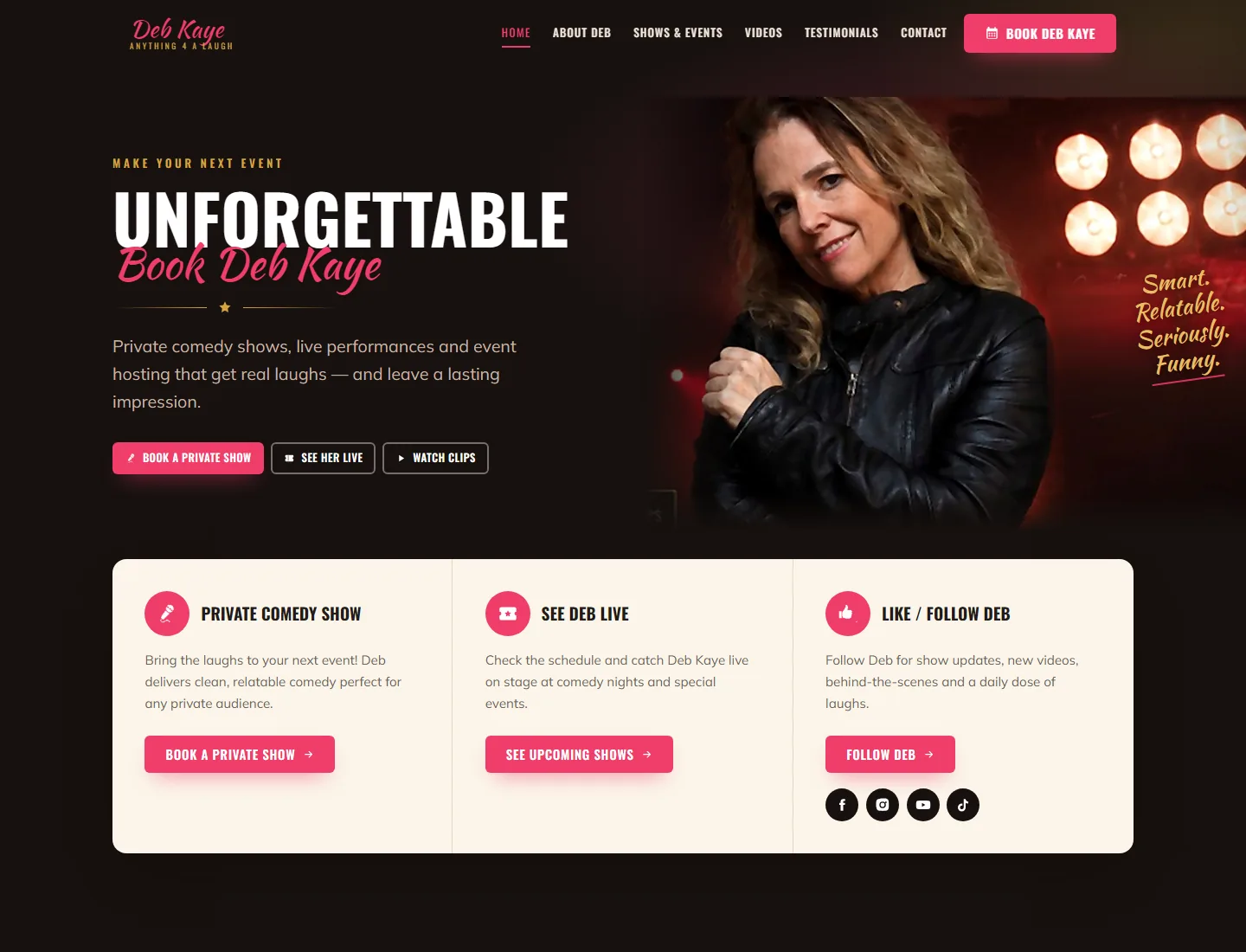
The project README explicitly names the two priorities: get booked for private gigs and showcase upcoming shows. The homepage follows that distinction with “Book a private show,” “See her live” and “Watch clips.” The first two actions serve different visitors; clips help both assess the performer.
Below the introduction, three panels repeat the routes to a private show, public dates and following Deb. This repetition is purposeful because it occurs after a visitor has seen the performer and description. It does not require the visitor to reinterpret a different set of labels.
The design keeps the performer visible
The captured homepage pairs a large photograph of Deb holding a microphone with condensed white display lettering. Rose-pink booking buttons and script accents sit against a dark stage-like background. The cream panels below provide a quieter surface for descriptions and secondary links.
The README identifies Oswald for condensed display type, Kaushan Script for brush-style accents and Mulish for body text. The distinction is practical: personality sits in short headlines and accents, while the longer descriptions use a simpler face.
Booking is an enquiry, not an instant ticket purchase
The source implements a booking modal that can be opened from the homepage and the Shows page. The form collects name and email, with phone and preferred date optional; it also asks about the event type and location. A booking visitor stays on the current page while describing the request.
The modal has a labelled dialog, a close button and a backdrop. Those are useful parts of the interface, but source inspection is not a complete accessibility audit. Keyboard focus, closing behaviour and readable error messages still need browser testing.
Show updates are separated from layout changes
The frontend uses static HTML, CSS and JavaScript. The repository describes a Google Sheet-backed show list, and the JavaScript includes a feed reader plus a built-in fallback. The content model includes title, venue, city, date, time and ticket URL.
The forms backend contains separate handlers for enquiries, subscriptions and content updates. That separation means an event can be updated without redesigning the page. It also introduces an external dependency: feed availability and form delivery need to be monitored rather than assumed to work because the homepage renders.